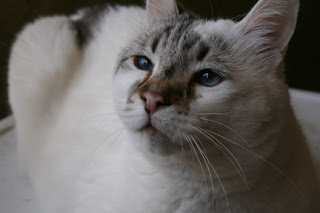
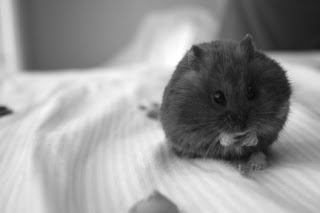
I thought I'd expand my amateur photography portfolio with some pet portraits. I've experimented with a lot of canine photography, but these 2 are amongst my first cat and hamster photos. Cats are very photogenic; it seems that cats can look elegant in most any pose they strike. I followed 2 hamsters around a bed top for twenty minutes, and captured only a few photos in which they were not blurs of fur.
I don't have any formal photography training, in either digital or manual, though I've always been an avid photo taker. Adjusting for light and shutter speed and all the other things one can fiddle with, does not come intuitively to me. So when I'm taking impulsive photos, I compensate for my lack of camera knowledge by finding a composition that best captures my subject. Eventually I'll get the hang of and take advantage of all those camera options on my Canon EOS.
Designing pirate clothes and accessories was a refreshing change from drawing sea life. Here are four characters that kids will encounter in Birch Aquarium pirate-themed birthday parties. Naturally I included non-human animal friends.
My illustrations always start their lives as pencil drawings, but rarely does any trace of pencil show up in the final versions. I am most comfortable drafting in pencil; more specifically, with an H or 2H Staedtler Mars Lumograph pencil. The leads are on the hard side, which I prefer because I like clean lines that don't get smudged easily, and I don't have to stop to sharpen very often. I rely also on my Staedtler Mars Plastic eraser. I've used a lot of erasers and that's my favorite.
You might recognize the top left drawing from an earlier post, which is the same composition, except in color. I scan these pencil drawings, and then trace over them in Photoshop, using my tablet and a thin brush. Then I delete the pencil layer, proceed to color, and add in the background.
Silhouettes are stylish right now. I've seen them used a lot in ads targeted at the young adult crowd. Think ipod, for example. Silhouettes of branching trees, birds, and wild flowers are popular graphic design elements. I have to admit, I like the clean, opaque, matter-of-factness of silhouettes too, and for a while, admired graphic artists for having the eye to distill a detailed image down to its outline.
That was before I did much computer art. Now I know that silhouettes are probably the easiest images to make. Perhaps it's obvious - all it is, is a tracing of an outline of a shape from a photo, and then filling it in with a single color. On a computer, it's extremely easy, and can be done while listening to podcasts or mentally untangling the revelations from the most recent Lost episode.
Here I tried to show off the diversity of sharks, solely by their shape. They have elegant profiles, especially the thresher shark, with its elongate tail. It took a little while to balance the colors. And yes I made the most notorious shark pink on purpose.
It's a race. Sail fish, Mako shark and Generic Tuna (not to scale). Achieving record speeds of 68 mph, 60 mph and and 43.4 mph respectively, according to my google search. Next time you're driving along at 68 mph, picture a sail fish keeping up in the lane next to you.
Notice how they're all counter-colored. That is, darkish on top, lighter on the bottom. It makes sense when you're living in the open ocean and trying to be camouflaged. From the top looking down in the water, it's dark to the stops of fish are dark, and looking up in the water, it's light so fish bellies are light. Same coloring system goes for penguins. Actually the point of this image was not to show examples of counter-coloring, but to illustrate the fact that sharks are fast swimmers. Their speediness is partially due to their skin structure.
Here the hammerhead family has been incorporated into a Shark Eggs sign, along with a horn shark and swell shark, and their respective eggs.
Unlike even a deluxe set of 72 color pencils, using digital methods to color an image presents a seemingly infinite range of choices. Maybe that sounds like a good thing, but I find that rather than being creative, I may be tempted to choose colors from Photoshop-provided palettes.
Instead of resorting to this, I like to pick colors by sampling colors from photos of the animals I happen to be coloring, using the handy eyedropper tool. Sure the colors aren't completely accurate (filtered by water, lenses, photoshopping, etc), but the resulting palette is much more interesting, and consists of colors I never would have considered. It's not just a matter of eyedropper-ing any pixel's color though. Colors need to be layerable and blendable at different opacities, and most importantly that color needs to be symbolic of the object it is coloring. P.S. The title font is "Monkeyboy", free from 1001fonts.com.
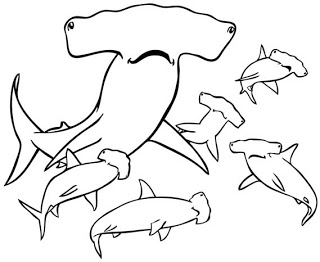
Some sharks give live birth, and some sharks lay eggs. Hammerheads fall into the former category, and can have 50 pups in one litter. However, hammerhead mothers don't provide any parental care, so I guess this one in the drawing stuck around long enough for a photo but has since swam off.
This is another image for the shark-themed birthday party series of illustrations. Hammerheads are easier to draw than pointy-nosed sharks because it's impossible to mistake a hammerhead for anything else.
When an old friend asked me if I were interested in illustrating Chinese children's books for his mom, I jumped for the opportunity. Apparently it's very difficult to break into the children's book illustrating business, because so many people want to do it and so many people are already doing it. I've had some kid's activity books published, printed in black and white on a photocopier. These books would be in color, with a glossy card stock cover!
I have 7 books to illustrate, each with three stories based on animal characters. The books are to be published in Hong Kong, and used to teach Chinese to kids. With each book, a few new Chinese characters are added to the kids' repertoire.
It's a little tricky working internationally; I've met with the author and publisher once, and have since only communicated via email. There's a slight language barrier, my first language being English and theirs, Chinese. Unlike my aquarium and natural history museum work, where I serve as my own art director, I have less aesthetic and compositional control with these children's book illustrations.
But, I Do get to draw cute animals, and that is my specialty. I drew this in pencil, scanned it, then outlined and colored in photoshop.
My drawings today featured sharks wielding kitchen tools that exemplify the shark's feeding mechanism. Here we have the whale shark with a sieve. There's also the tiger shark with a can opener, horn shark with a nut cracker, great white with a set of knives, and a mako shark with forks.Imagine actual teeth accompanying these pictures... match the tooth to the animal and kitchen utensil! Makes for a fun birthday party game a la Birch Aquarium.
Projects like these are educational for me too. I didn't know what a mako shark looked like, for instance, so I Google imaged it. They're huge, beautiful animals, as impressive as great whites, but are hardly as well known. There are photos of them athletically leaping out of the water. There are also photos of giant dead makos and mako heads, unceremoniously displayed with proud-looking people.
Cartoon style drawings don't come easily for me, but I'm working on it. It's a matter of practice; knowing what features to exaggerate, knowing how to inject charisma and cuteness into a character. In a sense, scientific illustration is easier in that it requires less activity from the creativity brain part.
I've had a hard time with cartoon sharks before. One of the difficulties is figuring out where to bend the head forward in a manner that is completely unnatural to a real shark but mimics the way a human head faces forward atop a vertical body. The anthropomorphizing helps with the likability of the shark character. Also, people are used to recognizing sharks from their profile (everyone knows what a shark fin looks like), or from a gaping teeth-filled mouth, a la Jaws. Here I wanted a front view, so that this shark could show off what I need to illustrate for an Aquarium birthday party activity: the fact that sharks have many rows of teeth. I was tempted to have a look at Finding Nemo or Shark Tale frames, to see how those artists had tackled these specific problems, but I decided not to, because I didn't want my style to be too influenced, and well, because it's a more effective experience to figure these things out for myself.
For a while, my sketches of sharks looked like whales with pointy teeth. Then I figured the pointy shark "nose" was really integral to defining a shark, and I moved the eye so that it was slightly over the mouth, rather past the end of the mouth (which is where whale eyes tend to be). Emphasizing the big mouth also helped. More shark cartoons to come...
Remember back to pre-college days when science experiments all worked? These sets of worksheets introduce kids to the use of scientific method, starting with a question, ample availability of data to collect, and a conclusive conclusion.
I just finished off a set of about ten worksheets. At the start, I'd been given the text, but the composition and illustrations were up to me. However, the bulk of the time today was spent on making and messing around with different files - small thumbnail tiffs for previewing, illustrator files for edits, and final versions as pdfs, for easy handling on the part of teachers. Alas, not all my work is artsy.
There are some animals are are more fun to draw than others, and one of those is the sea turtle. I think it is because its fluid yet structured lines lend itself well to brush and ink. Crustaceans are fun to draw, for the same reason. Sea urchins are not fun to draw.
This drawing will be in a small booklet called "Sea Babies", for a program at the Birch. I was asked to put a beach in the background. I'm actually not sure what sort of coastal habitat exists along beaches on which sea turtles hatch, so I made up an idealistic, mountainy foresty scene. Come to think of it, I should have drawn human habitat: a shoreline crowded with high rise buildings.
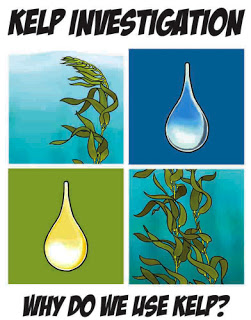
I frequently receive requests from the aquarium education department for "Station Signs". These orient kids in classes where they move from activity table (ie. station) to activity table to try different mini-experiments. In this case, kids learn why kelp is used in foods and other products. Hint... it has something to do with oil and water.
There are many kinds of educational programs, for example, Family Days, School Programs and Summer Camps. Part of my job is develop a different "look" for each of these. All station signs for School Programs feature illustrations in squares with block colors, and a title in Badaboom font, from 1001fonts.com. That's my favorite free font site by the way.
The Pacific Pocket Mouse is on the endangered species list, and is one of the species whose skull is up next to be drawn. I went to the San Dieogo Natural History Museum today and the mammalogist selected skulls based on where the specimen was found (being a guide book to San Diego Country mammals, they'd better be from San Diego), and skull quality (some are broken, stained, or from juveniles instead of adults). I also have 2 rat skulls coming up in my next batch of drawings, and I almost took photos of rat skins (skins are specimens gutted and stuffed, popsicle-like, as you see in the pic) but figured a pocket mouse might be cuter. As if skins could be cute.
The little jars to the left contain the skull, and sometimes bits and pieces of other skeletal parts. In subsequent posts, you'll get to observe the process of how a scientific illustration comes to be, via my technique. I'm self taught in this skull stippling business, and have streamlined the process by using electronic equipment, as you'll see. I used to be an idealist - I thought using electronic tools to aid my drawing was cheating. In real scientific illustrator life, those shortcuts are invaluable to (a) staying accurate (b) being time efficient and (c) maintaining sanity.
Ink and brush is a technique I picked up when I started drawing comic art in art school. Previously I swore by Sakura Micron pens, and while I still use those for scientific illustration, brush and pen (with exchangeable nibs) dipped in Speedball Superblack Ink are now my preferred drawing tools. I've tried mimicking the effect of brush and ink using computer drawing tools, but the feel nor the look are the same, so far. Not that this hermit crab hasn't been computer modified - it's been Live Traced in Illustrator, which nicely smooths gritty scans.
I'd been asked to spruce up a set of worksheets for aquarium classes. The current versions had a few bits of clip art thrown in as an after thought to liven up the page. Unfortunately, often the clip art was poorly suited for the purpose - for example, a photo of a sea urchin appeared to be a smudged dust bunny due to poor resolution. My illustrations, based on photos, are made with mass duplication in black in white in mind, as well as the potential for coloring with fat crayons. I try to strike a balance between accurate representation and whimsy, with personal art style and aesthetic composition thrown in. It's not about duplicating a photograph of a hermit crab - it's about extracting the essential elements from the photo (or several photos) that are most important in conveying the idea of a hermit crab, and interpreting those to form a new image.
I first met a kangaroo rat as an undergrad attempting to do some field research on wild mice in California. In one of our live traps (essentially, a box containing seed bait, a ball of cotton to provide warm bedding for a few hours, and spring-closed door) I caught a K-rat. These animals have huge heads, comprising about a third of the length of their body, and are surprisingly docile. This one calmly sat on my palm until it decided to bound off into the chapparal.
Almost a decade later, I'm drawing K-rat skulls for the San Diego Mammal Project guide book to SD county mammals as a freelance scientific illustrator. It's been a years long project, and the end is near. I have drawn about 70 mammal skulls, with about 10 to go. Now I look back at the stippled drawings I did 3 years ago, and want to redo them because I've refined my technique, and those initial ones look amateurish. But if I started that, I'd be drawing skulls for ever.
Why skulls? Mammals are hard to spot; hence the lack of mammal watchers like there are bird watchers. They're shy and many are nocturnal. What we see are bits and pieces of evidence of their existence - footprints, poop, and skeletons.
This is my first foray into blogging, and thus this post is accompanied by the first bit of artwork I did that involved a true combination of traditional pen & ink and Photoshop. The entire scene was colored using a laptop touch pad. I have since invested in a wacom tablet.
Most of my work is for the Birch Aquarium in San Diego. I make images, design graphic stuff, and occasionally make toys for the education department. I help out in the exhibits department as well, for example, by creating concept drawings when we're designing exhibits. I like thinking that my artwork serves the purpose of inspiring people to appreciate and to become interested in biodiversity and the natural environment. That can happen in the smallest ways, such as a tiny black and white illustration on a kid's worksheet, to this tide pool scene you see here, designed to be a large scale backdrop for a tide pool class for kids who perhaps have never seen a tide pool before.
I have a lot of fun projects, and I realized that I want to document the fun stuff that I produce. And why not share my artwork too? I figure most people don't even realize that there are artists working behind the scenes at museums, to make the museum experience as great as possible for visitors. Hopefully you'll get some insight into making art for non-art museums, as well as peek at my creative process. On this end, it will be helpful for me to practice talking about and critiquing my work. It's been a year since I finished art school, and I have to admit, I miss the artsy discussions we had on a daily basis.